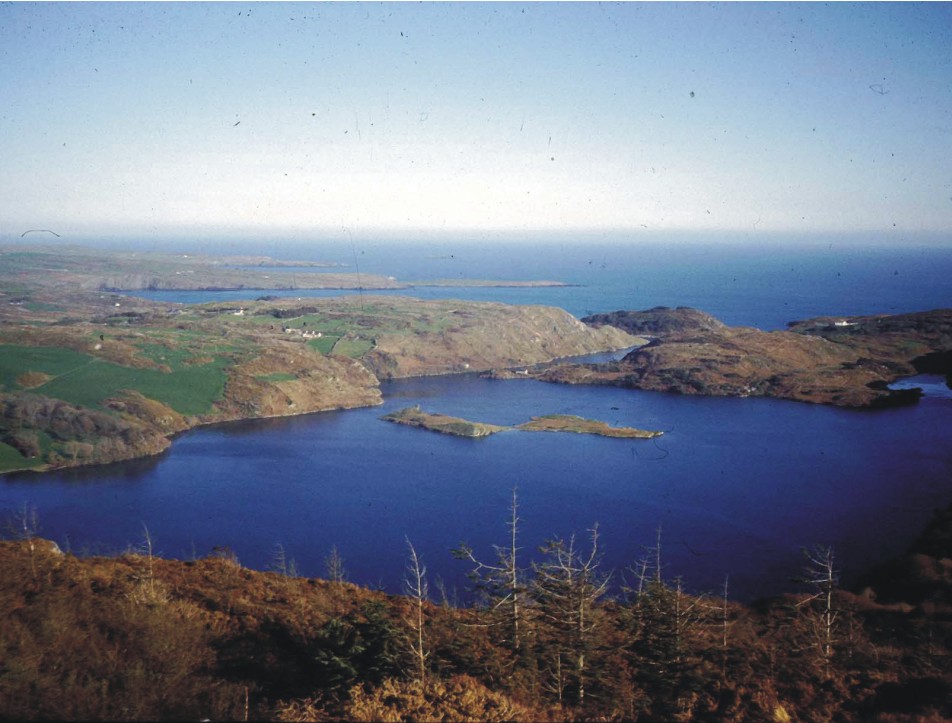
Synoptic description of site:
Full salinity marine 'lake' connected to the sea by a shallow narrow set of tidal rapids. |
Extensive description of site:
Lough Hyne is a deep landlocked bay or ‘marine lake’ joined by a narrow channel (Barloge Creek) to the sea. Approximately 4,000 years ago in post-glacial times it was a freshwater lake and due to the post-glacial sea-level rise is now saline. The narrowness of the connecting sea channel restricts tidal fluctuations to about 1m and consequently the zonation of the intertidal communities is confined to a narrow band. The rapids created in the narrow channel when the tidal levels inside and outside the lough differ are of note.
During the summer the lough becomes highly stratified with severe anoxia occurring in the sediments below the thermocline. This is atypical of the region, however it is a very localized event. Since no large estuaries enter the coast along the shoreline in the conditions throughout the region are fully saline.
Lough Hyne is the only National Marine Nature Reserve in Ireland. Established in 1981 and managed by Dúchas–the Heritage Service, the Lough has interpretive boards explaining the importance of it as a marine reserve and is promoted locally as such. It is also a proposed candidate Special Area of Conservation (pcSAC) and Natural Heritage Area. The byelaws of the Marine Stature Reserve Status are strictly followed. No activities are permitted within the bounds of the reserve without prior application for a license. | Habitats present:
| | Mud | Sand | Rock |
| Littoral | X | X | X |
| Sublittoral | X | X | X |
| Seagrass beds | X |
|
Description of fauna and flora:
Lough Hyne has been extensively studied and is known to have a very high species diversity and very high species richness for such a small area. On the open coast and within the Lough the rocky shores support the Mediterranean sea urchin Paracentrotus lividus which is at its most easterly limit in Ireland. Dense stands of kelp Laminaria saccharina occur in the rapids with species rich underboulder communities. Within the lough the shallow subtidal reefs have mixed kelp forests with dense foliose red and brown algae. With increasing depth communities more characteristic of wave exposed occur; sponges hydroids, cup-corals, solitary sea squirts and red algae dominate the boulders. The vertical surfaces are colonised by jewel anemones, sponges and solitary sea squirts. Cobbles, pebbles and gravel support a communities of keel worms Pomatoceros triqueter, barnacles Balanus crenatus and bryozoan crusts.
In sheltered areas solitary sea squirts and sponges cover much of the rock. The cliffs support a wide variety of sponges, including the rare Plakortis simplex and Halicnemia patera, cup corals, the Lough is the only known site in Ireland for the southern cup coral Caryophyllia inornatus and the soft coral Parerythropodium coralloides. Two rare gobies have been recorded, Couch’s goby Gobius couchi and the Red-mouthed goby Gobius cruentatus and two sea slugs Dicata odhneri and Facelina dubia more commonly found in the Mediterranean. Seventy-five percent of Irish marine algae have been recorded in the area including Osmundea truncata, Gymnogongrus devoniensis and Notastoma canariensis.
Much of the seafloor is soft mud, although areas of pebbles and gravel colonised by solitary sea squirts and muddy sand colonised by burrowing anemones occur. The scallop Pecten maximus is present with the Dublin Bay prawn Nephrops norvegicus which is common. |
Pristiness: Moderate |
Justification:
Strictly protected since 1981 Lough Hyne has been the subject of intensive research effort (ca. 300 publications) for over 110 years. It is a popular dive site. Although now strictly control this was not the case in the past. Angling and prawn potting, on a small scale, is permitted in the reserve. |
Human impact:
There is no industrial pollution, mining, dumping or dredging activity within Lough Hyne. Agricultural pollution is negligible with likely low inputs of nutrients from surrounding farmland. The surrounding countryside around Lough Hyne has a few private houses and the population is unlikely to increase significantly. Sewage from these houses would generally go into septic tanks or cesspits.
No commercial fishing occurs within the reserve boundary, although one license is held by a local fisherman to set prawn pots in the Lough. Some potting and drift net fishing may occur along the open coastline, however this would be outside the reserve boundary.
The number of tourists visiting the Lough is low. The main activities would be walking and photography. Any activity within the Lough requires a license, although some limited angling may occur in the Lough itself and along the open coast. |
Facilities:
The open coast section is generally not accessible in winter however the Lough itself is accessible in all weather conditions. It is accessible by car with launching facilities for boats. The maximum distance by boat to the open coast is less than 2 km.
Three small laboratories, two with electricity are available on site, providing facilities for accommodation, kitchens, aquaria, sample sorting, preserving, identification and experimental research. The closest university laboratory would be in Cork, approximately 50-60 km away. The laboratory has a small compressor for diving and space for drying gear.
There are adequate boats available onsite although no boats are allowed on the lough without a license. Guest facilities are available. There are many guesthouses and self-catering cottages available locally and camping has been practical for over 40 years. |
Available database and website:
Limited information is available on the BioMar viewer CD (Picton & Costello 1998). There would not be a comprehensive electronic database of other information for Lough Hyne.
BIOMAR data is available from http://www.ecoserve.ie/projects/biomar |
Links:
|
Commitment and ongoing research:
Regional catchment management plans under the Water Framework are currently being commissioned. This should lead to some biodiversity monitoring programmes being established. The management plans for marine SACs are currently being examined and there is a requirement by the National Parks and Wildlife Service to undertake some biodiversity monitoring as part of this designation. Long-term monitoring is completed there voluntarily by Dr Colin Little from the UK.
University College Cork owns the three small laboratories on the shore of Lough Hyne thus although there is no formal commitment the facilities allow graduate studentships to work there, and has a long term commitment to conduct research there. There is a requirement by the National Parks and Wildlife Service to undertake some biodiversity monitoring as part of the SAC designation. |
Involvements:
|
Additional Information:
Picton, B. E. & Costello, M. J., Eds. 1999. BioMar biotope viewer: a guide to marine habitats, fauna and flora of Britain and Ireland. Trinity College, Dublin, Environmental Sciences Unit.
Marine Institute 1999. Ireland's Marine and Coastal Areas and adjacent Seas: An Environmental Assessment. Dublin. |